Michael E. Byczek
Attorney
Patent Drawings
All patent applications require at least one drawing with very few exceptions. Design patents usually require at least six to show each perspective.
The majority of patent drawings require reference numbers to identify elements, components, and parts. These numbers are used throughout the written description to describe and explain how the invention works and is used. It is very important to correctly number these elements in a sequential and consistent manner.
About Patent Drawings
The USPTO has strict guidelines for technical drawings that must be followed when submitting an application. Drawings that do not conform to these standards may be rejected.
The purpose of a drawing requirement is to visually convey all of the details that describe how the invention works and is used. The written description and drawings must match.
-
Utility Patents: All features and functionality
Design Patents: Every view
Plant Patents: Distinguishing characteristics
There are several different types of drawings depending on the type of invention, or what the inventor wants to explain.
Orthogonal Views (2-D)
- Front
- Rear
- Top
- Bottom
- Left
- Right
Perspective Views (3-D)
- Front
- Rear
- Top
- Bottom
- Left
- Right
Other Views
- Exploded
- Sectional
- Electronic Schematics
- Block Diagrams
- Flowcharts
- Chemical Formulas
- Waveforms
- Tables
- Plots
Graphical techniques
- Shading
- Hatching
- Projection Lines
- Lead Lines
- Brackets
- Labels
- Numbers
- Letters
- Reference Characters
- Scale
- Paper Orientation
- Margins
- Type of Paper
Examples
These actual patents from the USPTO show one drawing from each registration to show different ways that a drawing conveys information about the written description.
Tesla Inc
Control system for an all-wheel drive electric vehicle
(9,527,406) granted on 12/27/2016
18 total drawings
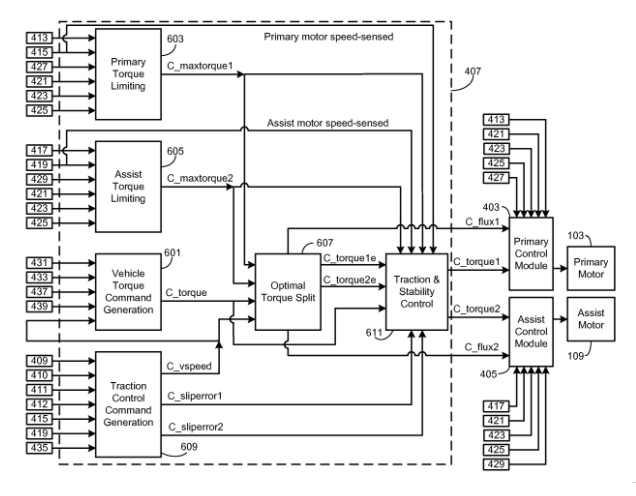
Described as illustrates the basic elements of a dual electric motor drive system for use with the present invention
Apple Inc
User interface for camera effects
(9,716,825) granted on 7/25/2017
Total of 158 images
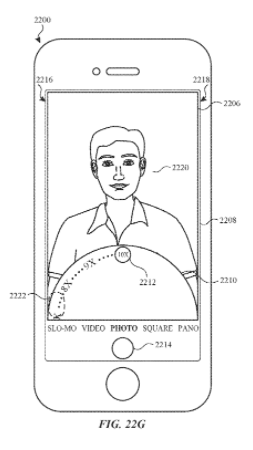
One in a series of illustrations referred to as illustrate exemplary devices and user interfaces for navigating through a plurality of values, in accordance with some embodiments
Whirlpool
Toaster
(7,351,939) granted on 4/1/2008
Total of 36 drawings
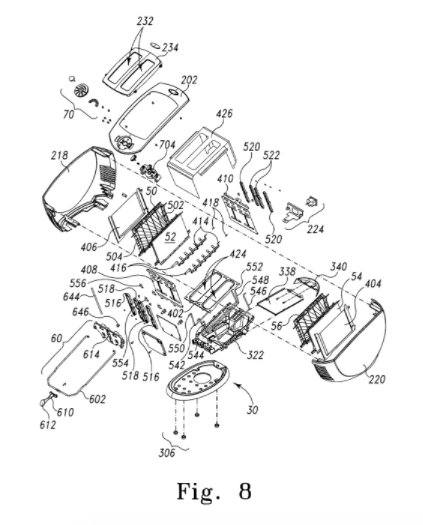
Described as an exploded view of the toaster of the present invention
Amazon
Method and system for placing a purchase order via a communications network
(5,960,411) granted on 9/28/1999
Total of 11 drawings
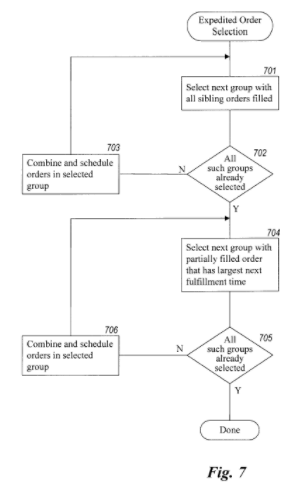
Described as a flow diagram of a routine that implements an expedited order selection algorithm